
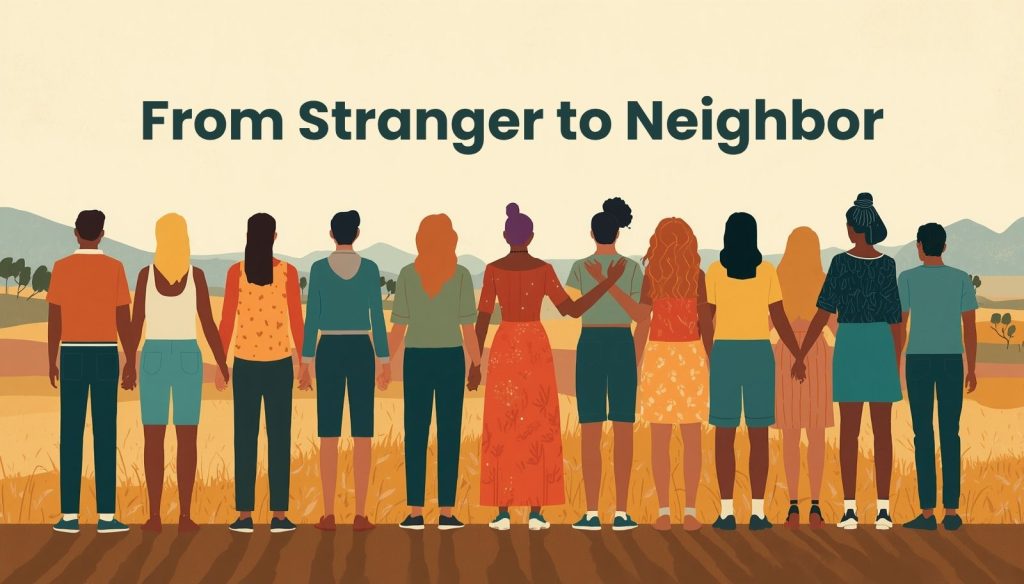
Learnings from From Stranger to Neighbor
This summer, the Wake Interfaith Immigration Network brought together people of faith from across Wake County to gather, learn, and grow through From Stranger to Neighbor, a four-part education series that ran from June through August 2026. Each session approached the call to welcome the stranger from a different angle, exploring what our sacred texts say, how our traditions have lived out that call across history, and what that call asks of us in this moment.
People came with open hearts and open minds, ready to listen and to share. Across four sessions and multiple faith traditions, participants discovered how much they hold in common: a deep conviction that every person bears dignity, and that communities of faith are called to act on that conviction together. The conversations were honest, the learning was rich, and the connections made across traditions will continue to bear fruit in our work ahead.
Below you will find videos and summaries from each session. We invite you to watch, reflect, and share these resources with your faith community, family, and friends.
1. From Stranger to Neighbor: Sacred Texts in Conversation
Tuesday, June 23, 2026
Beth Meyer Synagogue
504 Newton Rd. | Raleigh, NC 27615
We know we are all called to love our neighbor and welcome the stranger. We will examine how each of our faith traditions voices that call. How do words written centuries apart in communities all around the world help us understand how we can partner together to accomplish this holy work?
2. From Stranger to Neighbor: Dive Deeper
Sunday, July 12, 2026
Millbrook United Methodist Church
1712 East Millbrook Dr. | Raleigh, NC 27609
We know we are all called to love our neighbors. That’s the easy part. Dive deeper into our sacred texts to see how that call has been interpreted over the centuries. Do we all understand that call the same way? Where do we agree and where do we differ? How can that understanding guide us in our holy work?
3. From Stranger to Neighbor: In the past…
Sunday August 9, 2026
St Andrew the Apostle Catholic Church Apex
3008 Old Raleigh Rd. | Apex, NC 27502
We know that the call to love your neighbor is part of the lived experience of every group that has come to America. How have our faith communities responded to that call? What have we done in the past to ease the way for our immigrant and refugee neighbors?
4. From Stranger to Neighbor: In the present
Sunday, August 23 | 4:00 – 6:00 pm
Islamic Center of Cary
1155 W. Chatham St. | Cary, NC 27511
Where do we go from here? What can we, as people of faith, do in this moment to help our immigrant neighbors navigate an increasingly difficult and hostile environment as they strive to make new lives for themself in Wake County, North Carolina?
Recap: Session 1, Sacred Texts in Conversation
Covenant: As believers from multiple faith communities, we commit to listen and to share; to be respectful, considerate, open, and authentic; and to be ready to learn and willing to compromise to seek common ground.
As a result of small group discussions, participants shared thoughts:
- Feel more empowered by opening up to each other
- All are created in the Divine image – created by ONE (God, Heshem, Allah)
- Feeling of Interbeing and Interconnection (from Buddhist text), interdependent on each other and stronger together
- People deserve charity and hospitality
- Hospitality is putting others’ needs before your own
- All are equal in God’s eyes, and we need to work harder appreciate each other’s humanity and to accept each other because we are all human and all one body
- Fear drives people apart, such as fear of brown people
- Surprise and pleasure in meeting and engaging with so many people from many different faith communities to come away with the beginnings of a shared understanding about each other. Trust across our differences.
Holy Texts and Discussion Questions
Texts #1
Jewish: “And G*d created humankind in the divine image, creating it in the image of G*d, creating them male and female.” Bible: Genesis 1:27
Muslim: from the Prophet Muhammed (SAW) “The believers, in their mutual love, mercy, and compassion, are like one body: when any limb aches, the whole body reacts with sleeplessness and fever.”
Baha’i: “O CHILDREN OF MEN! Know ye not why We created you all from the same dust? That no one should exalt himself over the other. Ponder at all times in your hearts how ye were created. Since We have created you all from one same substance it is incumbent on you to be even as one soul, to walk with the same feet, eat with the same mouth and dwell in the same land, that from your inmost being, by your deeds and actions, the signs of oneness and the essence of detachment may be made manifest…“ The Hidden Words Baha’u’llah
Hindu: “The Stranger is the Self — Ātman/Brahman Unity: The most fundamental teaching is from Advaita Vedānta (Shankara’s non-dualism): Aham Brahmāsmi (“I am Brahman”) and Tat tvam asi (“That thou art”). The divine essence in you is identical to the divine essence in every being. The ‘stranger’ is not truly other – the perceived separation is maya (illusion) to love the stranger is simply to recognize your own deepest Self in them.”
Buddhist: Rajiv Mehrotra in 2003: “Interbeing means “co-being.” You cannot be by yourself alone. You have to ‘internee’ with everybody and everything else.
For instance, if you look deeply into a flower you will find it is made of non-flower elements like sunshine, clouds, rain, and soil. Without these non-flower elements, a flower cannot exist. So, it is better to say that the flower ‘internees’ with the sunshine and it cannot be by itself, alone. It is the case with humans, also. I am here because you are there.”
Discussion Questions
There is a plethora of different human groups in the world divided by geography, culture, religion, and history. Over the centuries, some of these differences have made it difficult or even impossible for some groups to interact with each other peacefully.
- What do these texts tell us about the original (divine) intention for human societies? Are there commonalities among the various texts? Do any of them seem to be in conflict with each other?
- What do these texts tell us about the dependence or interdependence of human beings – both individually and as communities – on each other?
- How can our study of these teachings inform our behavior toward other human beings? How can they strengthen our call to support immigrants?
Texts #2
Christian (all): “Whatever you did for one of the least of these brothers and sisters of mine, you did for me.” Bible: Matthew 25:40
Catholic: “Every encounter with a migrant is an encounter with Christ.” Pope Francis (2004)
Hindu: Atithi Devo Bhava — The Guest is God “The Taittirīya Upaniṣad famously declares Atithi devo bhava — “Let the guest be your god.” In practice, a stranger who arrives at your door is to be welcomed as a divine manifestation. This wasn’t merely cultural hospitality; it was a spiritual discipline recognizing the sacred in the unexpected visitor.
Jewish: “…since human beings were created in the image of G*d, there is a little bit of divine in every human being….In a sense then, greeting one’s fellow human being by using G*d’s name is like greeting G*d by using G*d’s name.” Mishna Berakot 9:5:5
Discussion Questions:
- How do these texts understand the relationship between human beings and the divine?
- How do these texts direct people of faith to act on immigrants’ behalf, specifically immigrants who are law abiding and contributing to US society such as undocumented longtime residents without a criminal history who work and pay taxes?
Texts #3
Quran Surah Al-Baqarah (2:177) “Righteousness is not in turning your faces towards the east or the west. Rather, the righteous are those who believe in Allah, the Last Day, the angels, the Books, and the prophets; who give charity out of their cherished wealth to relatives, orphans, the poor, ˹needy˺ travelers, beggars, and for freeing captives; who establish prayer, pay alms-tax, and keep the pledges they make; and who are patient in times of suffering, adversity, and in ˹the heat of˺ battle. It is they who are true ˹in faith˺, and it is they who are mindful ˹of Allah˺.”
“There is neither Jew nor Gentile… for you are all one in Christ Jesus.” Bible: Galatians 3:28
The utterance of God is a lamp, whose light is these words: Ye are the fruits of one tree, and the leaves of one branch. Deal ye one with another with the utmost love and harmony, with friendliness and fellowship…So powerful is the light of unity that it can illuminate the whole earth. The One true God, He Who knoweth all things, Himself testifieth to the truth of these words. Baha’u’llah
“The community shall have the same rule for you and for the stranger residing among you… You and the stranger shall be alike before the Lord. One law and one ordinance shall be for you and for the stranger who resides with you.” Bible: Numbers 15:15–16
The Good Samaritan: “Which of these three do you think was a neighbor…?” Bible: Luke 10:25–37
Vasudhāiva Kuṭumbakam “The World is One Family.”
From the Mahā Upaniṣad (and echoed in the Hitopadeśa): Vasudhaiva kuṭumbakam —
“The whole earth is one family.” This is perhaps Hinduism’s most universalist social teaching. There are no strangers in the deepest sense — only family members not yet recognized as such.
Discussion Questions:
- Clearly the world is made up of many different races, religions, nationalities, and ethnic groups. Those differences matter. How, then, can we understand “The whole earth is one family.”?
- If there is “no Jew or Gentile…” why do differences exist among communities large and small?
- Both the Muslim and the Baha’i texts enjoin us to treat everyone with kindness, love, and understanding regardless of who they are or where they come from. Is that possible?
Texts #4
Quran – Surah Al-Hashr (59:9 )“As for those who had settled in the city and ˹embraced˺ the faith before ˹the arrival of ˺the emigrants, they love whoever immigrates to them, never having a desire in their hearts for whatever ˹of the gains˺ is given to the emigrants. They give ˹the emigrants˺ preference over themselves even though they may be in need. And whoever is saved from the selfishness of their own souls, it is they who are ˹truly˺ successful.”
“No, this is the fast I desire: To unlock fetters of wickedness, And untie the cords of the yoke To let the oppressed go free; To break off every yoke. It is to share your bread with the hungry, And to take the wretched poor into your home; When you see the naked, to clothe them,…” Bible: Isaiah 58:6-7
Karaniya Metta Sutta: The Buddha’s Words on Loving-Kindness
“…Let none deceive another,
Or despise any being in any state.
Let none through anger or ill-will
Wish harm upon another….
…Even as a mother protects with her life
Her child, her only child,
So with a boundless heart
Should one cherish all living beings;
Radiating kindness over the entire world:
Spreading upwards to the skies,
And downwards to the depths;
Outwards and unbounded,
Freed from hatred and ill-will.
Whether standing or walking, seated or lying down
Free from drowsiness,
One should sustain this recollection….”
“Justice, justice shall you pursue, that you may thrive and occupy the land that your God יהוה is giving you.” Bible: Deuteronomy 16:22
Discussion Questions:
- People are people. Is it possible for people – either individually or in large or small groups – to think of others before they think of themselves?
- The Torah text calls on us to not only advocate for justice but to “pursue” it. What would pursuing justice look like? How does the pursuit of justice relate to not “deceive another or despise any being in any state”?
- Do the Muslim text from the Koran and the Jewish text from Isaiah agree with each other? Are there places where they are in conflict? How do they embellish the concept of pursuing justice?
Texts #5
יהוה said to Cain, “Where is your brother Abel?” And he said, “I do not know. Am I my brother’s keeper?” Bible: Genesis 4:9
“Which of these three do you think was a neighbor…?” Bible: Luke 10:25–37
“Do not stand (idly by) the blood of your fellow [Israelite]: I am יהוה”. Bible: Leviticus 19:16
“You shall not deprive the stranger or the orphan of justice.” Bible: Deuteronomy 24:17